
Inheritance and document management
Inheritance proceedings
-
- Documentation compilation
- Application for last will and testament
- Settlement of inheritance tax
- Declaration of heirs
- Acceptance of inheritance and partition
- Acceptance of inheritance and partition
Inheritance is an extraordinary event in a person's life, one that is often only encountered once. This justifies, on the one hand, the novelty of the situation and the need for professional guidance, and on the other hand, this very exceptionality makes it difficult to find companies that truly specialize in it. Therefore, after the death of a loved one, we must address a series of questions that can be resolved by choosing the right professional, or, conversely, a long period of uncertainty may begin, during which inefficiencies can be very costly.
The first idea that comes to mind is to consult a lawyer. However, due to the unusual nature of the case, they will most likely not be specialized in the process, and the outcome will be delayed, significantly increasing the final costs. Another option might be to go directly to a notary to save on the overall cost, but this can actually increase it, as a notary's involvement isn't always necessary, and even when it is, they typically rely on other professionals to complete their services.
Ideally, you should look for a company or professional specializing in these matters, such as GRUPO RODESPI.An inheritance can give rise to very diverse cases, requiring suitable professionals, or conversely, if it is a very simple case, contacting the right professional will give us complete security when carrying out the transactions.
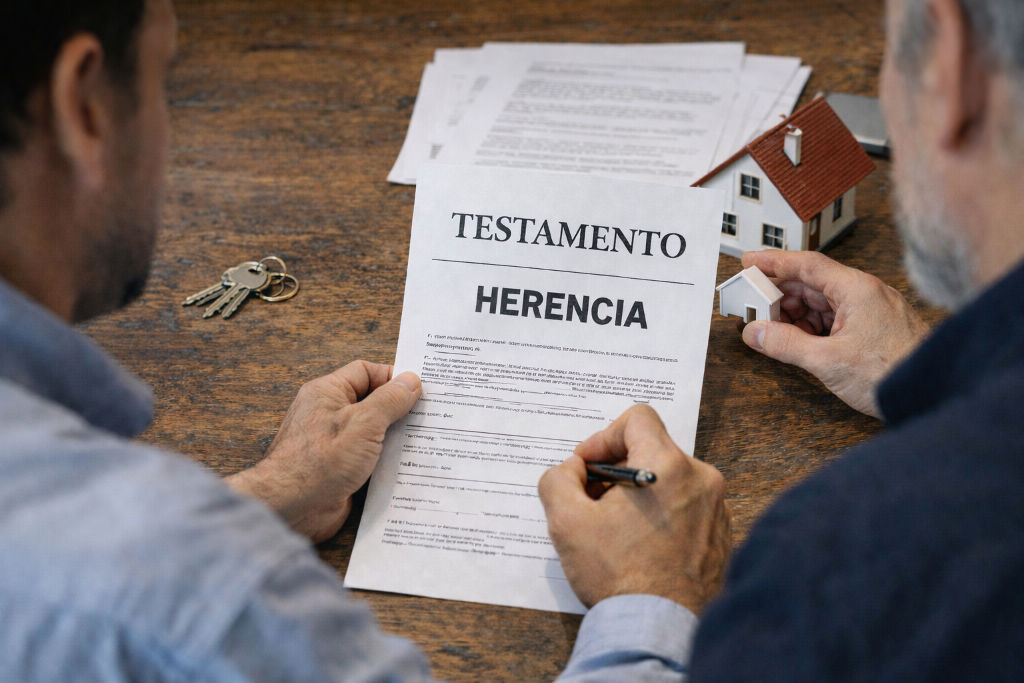
At GRUPO RODESPI, we specialize in inheritance services. We have a multidisciplinary team that conducts a thorough legal and tax analysis of each transaction, along with technical staff to handle all aspects related to property identification, boundaries, land registry, and more. This allows us to determine the appropriate documentation for each case and approach the notary with a perfectly defined plan, guaranteeing our clients complete peace of mind throughout the process. In short, we offer a multidisciplinary team that enables us to provide services with the utmost legal and tax rigor, efficient processing, and highly competitive pricing.
BENEFIT FROM OUR
SPECIAL PACK «GALICIA»
FOR ONLY €500 + VAT
INCLUDES
-
- Complete compilation of legal documentation.
All the necessary documentation for the inheritance settlement procedures. - Collection of heritage documentation.
Inventory of goods - Inheritance settlement.
Necessary procedures before the competent Administration.
- Complete compilation of legal documentation.
Preparation of partition notebooks
For those who wish to distribute their assets among their future heirs during their lifetime, we offer the option of preparing partition deeds. We handle the analysis and documentation of all assets, their valuation, the creation of separate lots, and so on, ensuring that our client's wishes are clearly reflected in the partition deed.
Other document management
We handle all types of procedures with various public administrations, such as city councils, the Galician Regional Government, the River Basin Authority, legalization of works and constructions, complaints to the Agency for the Protection of Urban Planning Legality, etc. Tell us your problem, we will analyze it and give you the best solution.
Frequently Asked Questions
Is it advisable to make a will?
Yes, for many reasons: it avoids the need for a declaration of heirs in cases of intestacy, it can leave the surviving spouse in a better position by granting them more rights than they would otherwise be entitled to by law, etc. Furthermore, if you have no relatives, making a will is very important because otherwise the State or an Autonomous Community will inherit, depending on the circumstances. On the other hand, a notarized will has a low cost: around €40.00 per will.
Will and declaration of heirs, are they the same thing?
No. They are different things (the declaration of heirs is only made if there is no will):
-
- Will: a document - usually notarized - made by a person, naming their heirs.
- Declaration of heirs: a judicial or notarial document required when a person has died without leaving a will. In it, the judge or notary states who the deceased's heirs are.
I have a will in which I leave rights to my spouse, but now I am divorced: Do I have to change it or are the provisions in their favor no longer valid?
Although it may seem strange, in principle and according to the Spanish Civil Code, testamentary provisions in favor of a spouse are not automatically revoked in the event of separation or divorce. Therefore, it is very important that, in the event of divorce or separation, the will be amended to expressly exclude the former spouse. Failure to amend the will can lead to problems and litigation in the future.
However, in Catalonia, Aragon or Galicia, their respective civil laws establish that testamentary provisions in favor of the spouse are rendered ineffective in these cases of marital crisis.
Can I pay inheritance tax with inheritance money that is deposited in a bank or savings bank?
Yes. Despite what many credit institutions may tell you or how they may try to prevent you from doing so, you are not obligated to pay inheritance tax with your own money; you can also pay with cash, shares, or inheritance insurance.
What is the deadline for paying Inheritance Tax?
In principle, six months from the date of death of the deceased, although an extension of another six months is possible. However, there may be some special provisions in the case of territories with fiscal autonomy.
What are last wills and testaments?
Every time a will is made before a public official (such as a notary), they notify the General Registry of Last Wills and Testaments in Madrid that the person has made a will. They don't send the original will, which remains with the notary, but only the essential information: the notary who made it, the date, the testator's name, etc. This information is then filed in the Registry. If the same person makes another will, the information is reported again. This is how the number of wills a person has made is known. When they die, a certificate can be requested from this registry ("last will and testament") which will indicate what wills they made, on what dates, and before which notaries.
Does the heir have to pay the debts of the deceased?
The person who accepts an inheritance is liable with all their assets (not just those inherited) for all the debts of the deceased (without prejudice to the special regime of Navarre). Therefore, if the debts are substantial or exceed the assets and rights of the inheritance, the possibility of renouncing the inheritance or accepting it "with the benefit of inventory" should be considered. Before taking any action, it is advisable to seek advice from a specialist, as the inheritance can be tacitly accepted and cause problems.
Can an inheritance be made if an heir does not want to sign the partition?
If an heir does not wish to make the inheritance voluntary, the process will have to be handled through the courts. However, this is not generally a good solution because it can be very expensive. The best course of action is to gather all the necessary documentation for the inheritance (will, last will and testament, bank statements, deeds, etc.) and discuss a fair distribution with all the heirs. If it is necessary to concede something, it is advisable to do so to avoid problems and delays.
Do unmarried couples have inheritance rights?
In principle, no. The Civil Code does not establish inheritance rights for unmarried couples. However, there are exceptions, as Catalan, Galician, Navarrese, Basque, and Balearic civil law must be taken into account.
There are only three of us siblings, and when I see my father's will, I see that he has left me the "strict legal share." What does that consist of?
In principle, the amount of the statutory share can depend on whether the inheritance is governed by the Spanish Civil Code or by regional laws. If the Spanish Civil Code applies, it means that your father has left you the minimum, which is 1/3 divided by the number of children (in this case, three), so he has left you 1/9. If, for example, the inheritance consists of a house valued at €180,000, you are entitled to 1/9, that is, €20,000.
